Heidelberg University
Heidelberg University’s Institute of Global Health (HIGH) advances research and education on global health challenges, focusing on evidence-based solutions for equitable healthcare worldwide.
- Climate Change Health
- Global Health Policy
- Transdisciplinary Methods

Universität Hohenheim
The Institute of Phytomedicine at the University of Hohenheim conducts research on plant health, focusing on plant protection, pest and disease management, and sustainable crop production.
- Agriculture Technologies
- Experimental Farming (Living Lab Ihinger Hof)
- Precision Farming & Robotics
Reutlingen University
Reutlingen University’s Herman Hollerith Zentrum (HHZ) focuses on digital transformation, applied AI, and IT innovation, linking academic research with practical solutions for society and business.
- Digital Environments & Transformation
- Business Models Food & Agriculture
- System Modelling

Stuttgart University of Applied Sciences
The Stuttgart University of Applied Sciences (HFT Stuttgart) offers innovative, practice-oriented education and research in engineering, architecture, business, and digital technologies.
- Digital Twins
- Logistics for agri-food supply chains
- IoT-based supply chain management
HEAL network
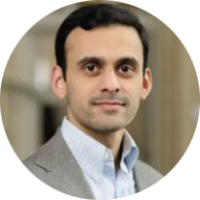
Dr. Anant Rajnikant Jani
His work focuses on improving population health by addressing social determinants of health. He is currently involved in Horizon Europe projects on redesigning food systems for healthier, sustainable diets and exploring innovative financing for disease prevention. Previously, he supported healthcare system reforms in Europe and the Middle East to promote value-based care.
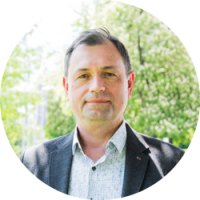
Dr. Sergej Pidan
He studies aerospace engineering at the University of Stuttgart, where he also completed his PhD on the topic of “Development of a catalyst-based sensor system for re-entry vehicles.“ After three and a half years of research in the field of materials for thermal protection systems for spacecrafts, Sergej moved to the aerospace industry, where he was involved in various national and international projects as a designer, developer and project manager between 2005 and 2021. In addition to his work at HFT, Sergej has been running an engineering services company since 2021.

Dr. Susan Jackson
Dr. Susan T. Jackson is a political scientist at the Heidelberg Institute of Global Health. Her research focuses on climate change adaptation and mitigation, marginalized communities, ethical research, and systems approaches. She leads the HEAL network on agri-food systems transformation and previously directed a major project on militarization and social media. Her work spans political science, public health, sustainability, and digital systems, using mixed methods and interdisciplinary collaboration.

Johannes Wahrlich
He holds a Master of Science in Product and Quality Management in Horticulture from Humboldt University of Berlin. His research focuses on comparing different farming systems and their impact on factors such as biodiversity, soil functions and product quality. In addition, Johannes is interested in developing sustainable weed control strategies within the framework of integrated weed management.

M.Eng. Annette Kunz-Engesser
• Project Management in Research Projects, open science
• Smart Cities, Architecture and Digital Processes
• Sustainability and circular economy

M.Sc. Reiner Braun
Reiner's research activities focus on developing energy and mobility concepts for regions and cities, IoT networks, data analytics, and developing urban data models to characterize the nexus of food, energy, and water at the neighborhood level. He has over 15 years of experience working on research projects.
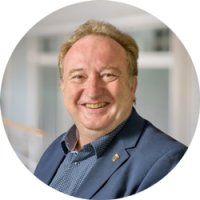
Prof. Dr. Dieter Hertweck
- Integrating the ecological and digital transformation
- Digital services for climate adaptation
- Digital circular economy business models
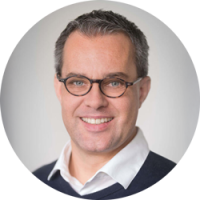
Prof. Dr. Dr. Till Bärnighausen
Till Bärnighausen is a population health researcher focused on: (i) assessing the impacts of major global health interventions like HIV treatment and vaccination; (ii) improving their delivery through public health systems; and (iii) advancing methods for population-based health research.
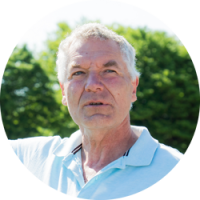
Prof. Dr. Roland Gerhards
His scientific interests are focused on Integrated Weed Management Systems and Precision Farming in sustainable cropping systems. For Precision Weed management, he has developed sensor and application technologies for automatic plant species recognition and site-specific weed control. His research has been supported by important funding institutions including DFG, EU, Ministries, foundations and companies. Roland Gerhards is a member of the German Phytomedicine Society (DPG) and the European Weed Research Society (EWRS). He has authored and co-authored more than 180 papers in peer-reviewed international journals and has reviewed manuscripts for many international Journals.
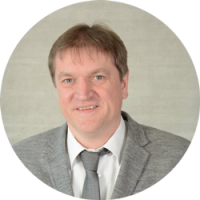
Prof. Dr. Volker Coors
Prof. Dr. Volker Coors is a computer science professor at HFT Stuttgart, specializing in urban digital twins, 3D geospatial data, and spatial visualization. He holds a PhD in computer graphics from TU Darmstadt and has been Vice-Rector for Research and Digitalization since 2023. He contributes to international standards via the Open Geospatial Consortium, co-founded Germany’s 3D City Models Commission, and serves as Vice President of the Urban Data Management Society.
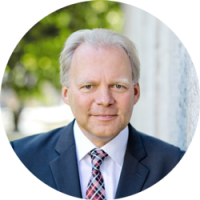
Prof. Dr.-Ing. Dieter Uckelmann
Professor Uckelmann focusses on applied research related to the Internet of Things in different application domains including logistics, production, food, buildings, construction and education.